

Common Bristlenose Catfish & Breeding Forms
For many aquarists, the “common” or brown bristlenose catfish is the first contact with the fascinating world of the armored catfish of the genus Ancistrus. It is considered robust, peaceful, and useful – and is also the starting point for numerous breeding forms such as albino, veil-tail, or yellow bristlenose catfish. Despite its popularity, many half-truths circulate about its requirements, origin, and breeding. On this page, we summarize the most important information about the brown bristlenose catfish and its breeding forms.
The wild form: the brown bristlenose catfish
Under the name “Common Bristlenose Catfish” or “Brown Bristlenose Catfish,” relatively uniform-looking animals are usually offered in stores, originally from tropical South America. In aquariums, the name Ancistrus cf. cirrhosus is frequently used, as these are often strains that have been bred in aquariums for generations. The question of their exact wild origin is the subject of current research: As part of a project by Dr. Rupert A. Collins, Senior Curator of Fishes at the Natural History Museum in London, comparative material from nature is being used to investigate which species is actually behind the common aquarium strains. He presents an initial interim conclusion in his guest article “Names stirred and shaken: Is Ancistrus martini the real ancestor of our common bristlenose catfish?” in our Ancistrus book.
Typical for the aquarium strains of the wild form is a brownish base color with irregular, lighter spots and dots. Adult males develop the eponymous “antennas” – fleshy skin growths – on the snout, while females show at most small growths on the edge of the head or do without them altogether. With a total length of about 10-12 cm, most animals remain comparatively small and fit well in medium-sized aquariums.
In the aquarium, the brown bristlenose catfish predominantly exhibits crepuscular to nocturnal behaviors. With sufficient hiding places, roots, and quiet areas, the animals can often be observed during the day as well. Wood plays an important role: roots serve not only as shelter but are also rasped.
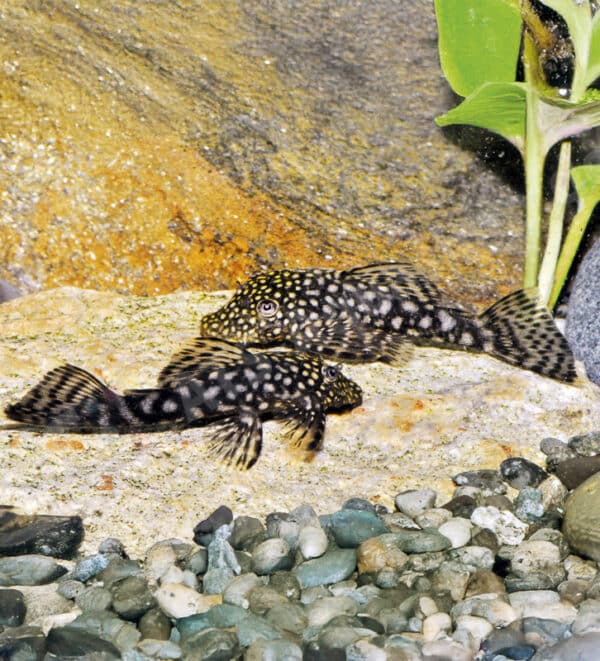
Ancistrus sp. “Aquarienstamm”, Photo: Ingo Seidel
Popular Breeding Forms of the Bristlenose Catfish
Over the decades, various color and fin variants have developed from the brown strain. They are widely kept and bred in aquaristics. In the following, we will briefly introduce the most well-known breeding forms.
Albino Bristlenose Catfish
Albino bristlenose catfish are among the oldest breeding forms. They show a creamy-white to slightly yellowish base color, red or pink eyes, and otherwise the same body structure as the wild form. Many aquarists appreciate albinos because they stand out clearly from the usual aquarium fauna and are easy to recognize even in dense vegetation.
In terms of keeping and breeding, albino bristlenose catfish hardly differ from the brown form. They are just as robust, also require many hiding places, wood, and plant-based food, and can be bred just as easily. You should pay attention to sufficient shady spots, as albinos can react somewhat more sensitively to strong lighting.

Ancistrus sp. “Albino II, Aquarienstamm”, Photo: Ingo Seidel
Veil-tail and Longfin Forms
Veil-tail or longfin bristlenose catfish are noticeable due to their elongated dorsal and caudal fins. Depending on the breeding line, the fins appear more or less “waving.” Combinations of veil-tail form and special color variants, such as albino veil-tail bristlenose catfish, are particularly popular.
When keeping such animals, you should pay attention to a calm current and peaceful tankmates. Fin-nipping species such as some barbs or larger tetras can damage the long fins. Even with veil-tail forms, it is important to pay attention to a healthy body shape and stable lines so that the animals remain robust and resistant despite their striking appearance.

Ancistrus sp. “Schleier, Aquarienstamm”, Photo: Andreas Tanke
The “Yellow Bristlenose Catfish” and L144
The yellow breeding form, which is often associated with the designation “L144” in aquaristics, is particularly well-known. Historically, the L-number L144 was assigned to a wild-caught form; however, today yellow breeding forms of the “common” bristlenose catfish are usually offered in stores, which are only conditionally identical to the original L144. The name is often continued out of habit, although in most cases these are color-bred aquarium strains.
The “yellow bristlenose catfish” shows a bright yellow to golden body color, often with few or no visible spots. It is a striking eye-catcher in the community aquarium but usually behaves just as peacefully as the brown strain. For a long-term stable breeding line, it makes sense to pay attention to healthy animals with good body structure and normal head and fin shape.
In the book “Bristlenose Catfish: The Armored Catfish of the Genus Ancistrus”, we discuss this confusion of names in detail. There we show, among other things, photos of real L144 and compare them to the yellow breeding forms of the common bristlenose catfish. Based on these comparison photos and additional background information, it becomes clear how the original L144 form and the now widespread aquarium strains differ and why the trade name “L144” is strictly speaking not correct for many yellow breeding forms.

Ancistrus sp. “Gelb Schwarzauge, Aquarienstamm”, Photo: Ingo Seidel
Other Color Variants
In addition to the classic albino and yellow forms, dedicated breeders have produced other color variants, such as reddish (“red”), marbled (“calico”), or particularly heavily speckled lines. Many of these variants are locally limited or only available through specialized breeders and are sometimes specifically selected to solidify certain patterns.
Regardless of the color, the following applies: the health and well-being of the animals should always take precedence over extreme breeding goals. A moderate selection for strong, vital animals is more sensible in the long term than the uncompromising pursuit of a “special” color tone.

Ancistrus sp. “Schildpatt, Aquarienstamm”, Photo: Ingo Seidel
Keeping in the Community Aquarium
The common bristlenose catfish and its breeding forms are rightly considered suitable for beginners – but only if a few basic rules are observed. An aquarium from about 80–100 cm edge length is usually sufficient for a pair or a small group. More important than the exact volume are numerous hiding places and structure: roots, stones, caves, and dense plant growth offer retreats and visual protection.
The water values may vary somewhat depending on the breeding strain and origin but are in many cases in the range of a typical community tank: moderately soft to medium-hard water and temperatures between about 22 and 28 °C. Short-term deviations are usually well tolerated by healthy animals, but stable conditions are always preferable.
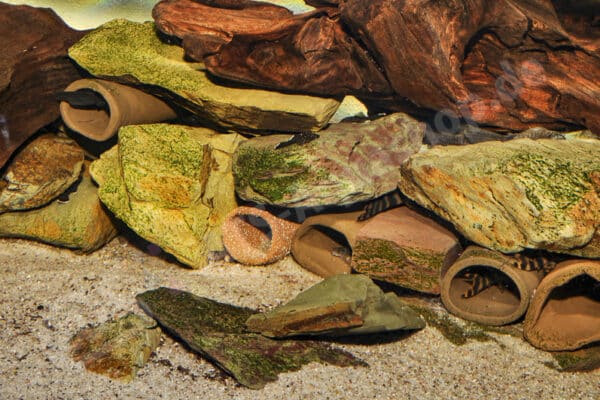
Holding tank for bristlenose catfish (Ancistrus), Photo: Ingo Seidel
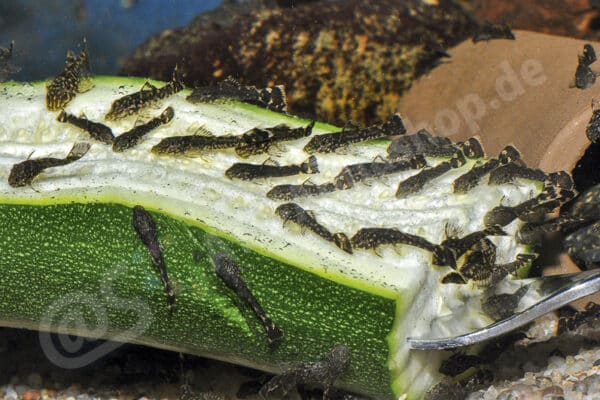
Ancistrus sp. “Aquarienstamm” also eat zucchini, Photo: Ingo Seidel
A common mistake in practice is the assumption that bristlenose catfish are “algae eaters” that feed solely on coatings on the panes. In fact, they are omnivores with a clear focus on plant-based food. High-quality catfish food with wood and plant content, vegetables (e.g., zucchini, cucumber, paprika), and occasional protein supplements (e.g., frozen food or special catfish granules) ensure healthy growth and strong colors. We have also summarized further information on keeping in this article: Bristlenose Catfish (Ancistrus) in the Aquarium: Keeping, Care & Breeding.
Breeding and Propagation
Breeding the common bristlenose catfish is considered relatively easy and succeeds for many aquarists even in the community tank. The animals are cave breeders: the male looks for a suitable cave, lures the female in to lay eggs, and then takes over the brood care. It guards the clutch, fans the eggs with fresh water, and drives away intruders.
After a few days, the larvae hatch, initially remain in the cave, and feed on the yolk sac. As soon as they leave the cave, they can be raised with fine dust food, crumbled catfish tablets, or freshly hatched artemia nauplii. In highly structured aquariums with many growth zones, they also find natural microorganisms and biofilms.
The process is basically the same for breeding forms. If you want to specifically maintain certain colors or fin shapes, you should select the parent animals accordingly carefully and avoid inbreeding and excessive selection. Regular crossing of strong animals from other lines can help to maintain vitality and fertility.
Breeding Goals with Discernment
Breeding forms are a major attraction of aquaristics – this also applies to bristlenose catfish. At the same time, it is important to pursue breeding goals with discernment and always put the health of the animals first. Extremely elongated fins, severely shortened body shapes, or exaggerated color patterns can be associated with health problems and impair the quality of life of the fish.
Responsible breeders therefore pay attention to:
- robust, well-developed animals with normal body structure,
- clear eyes, intact fins, and good general behavior,
- stable reproductive capacity over several generations,
- a sensible limitation of extreme characteristics.
This is how the common bristlenose catfish – whether brown, yellow, albino, or veil-tail form – remains a fascinating, but above all healthy companion in the aquarium.
More about Ancistrus and their Diversity
The brown bristlenose catfish and its breeding forms are only a small excerpt from the enormous diversity of the genus Ancistrus. Many other species, local forms, and L-numbers are presented in detail on Ancistrus.at with photos, profiles, and information on keeping. We have compiled the entire range of the genus – from frequently kept species to rare specialties – in the book “Bristlenose Catfish: The Armored Catfish of the Genus Ancistrus“. Particularly exciting for anyone interested in the origin of the aquarium strains is the guest article by Dr. Rupert A. Collins, Senior Curator of Fishes at the Natural History Museum in London: “Names stirred and shaken: Is Ancistrus martini the real ancestor of our common bristlenose catfish?”.
In it you will also find:
- detailed species portraits with numerous photos,
- background information on biotopes, origin, and variability,
- practical tips on keeping, feeding, and breeding,
- and many further information for beginners and specialists.
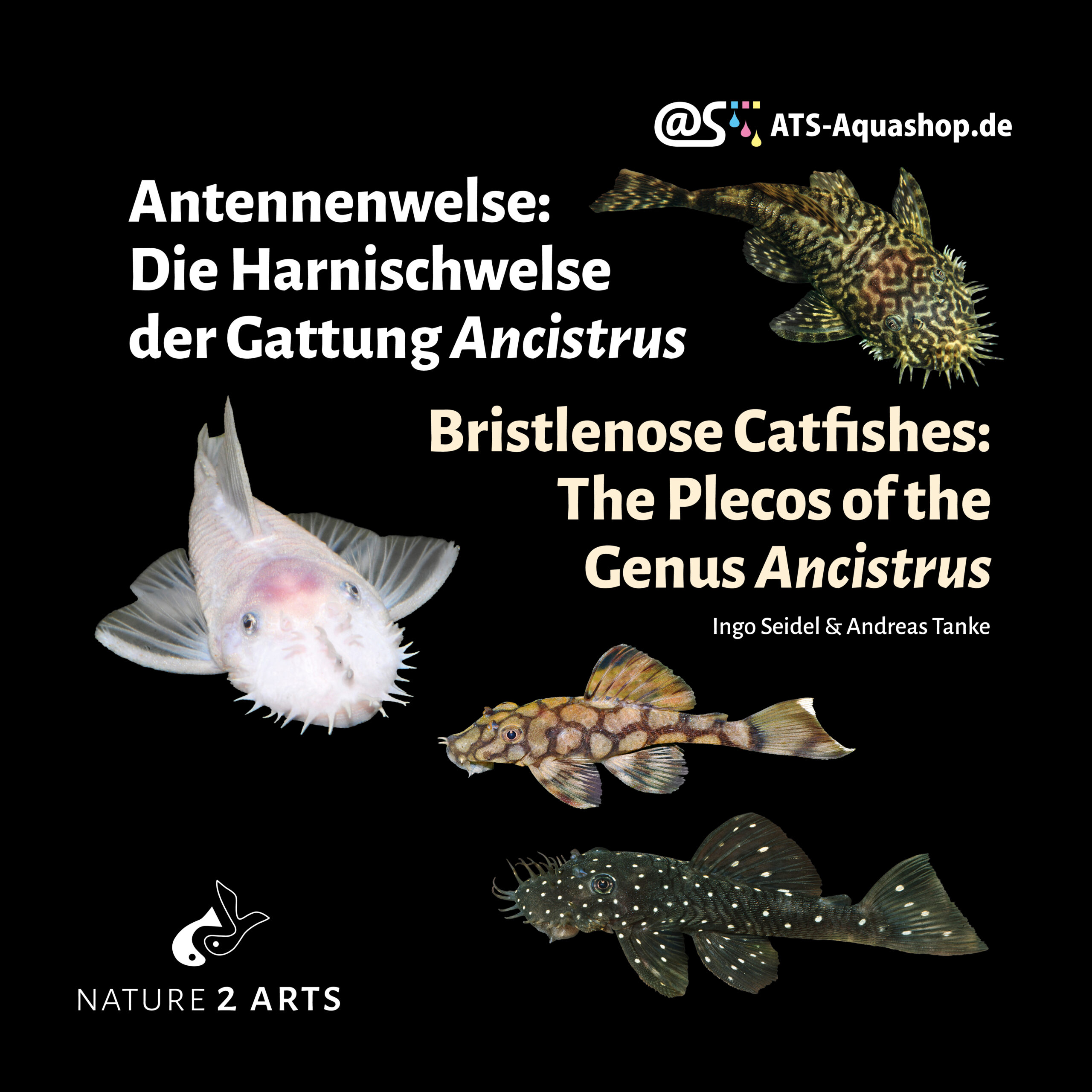
If you want to dive even deeper into the world of bristlenose catfish, it is worth taking a look at the book and the species list on Ancistrus.at, which is constantly being supplemented and updated.