
Breeding Bristlenose Catfish: Ancistrus Reproduction Step by Step
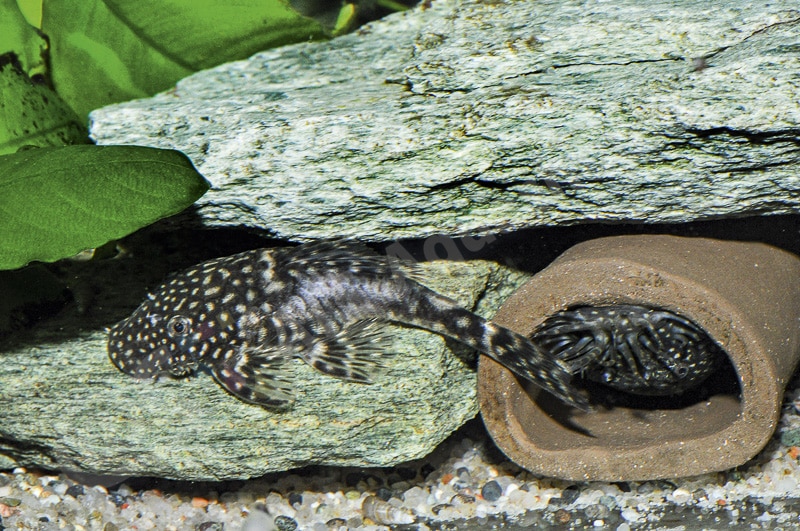
Female Ancistrus claro (left) and the male (right) in the clay tube, photo: Ingo Seidel
Bristlenose catfish of the genus Ancistrus are among the most popular catfish in aquariums – and they are often surprisingly prolific breeders under suitable conditions. To ensure that breeding is not left to chance, you don’t need a “secret recipe”, but a stable setup: healthy parents, a suitable breeding cave, clean, oxygen-rich water, and the right food for conditioning.
On this page you will find a practical step-by-step guide: from the selection of the animals to the cave setup and the rearing of the young fish – including typical errors and quick solutions.
New to Ancistrus? Read these first: What are Ancistrus Catfish? and Care, Keeping & Feeding – then breeding will be much easier.
Brief overview: Preparation, brood care, rearing
Breeding Ancistrus is considered quite feasible in aquaristics and is a major reason for their wide distribution. Nevertheless, it is worth taking a close look at the details – with a suitable setup and clean water, success increases significantly.
Preparation
- balanced diet for parent animals
- several suitable nesting cavities (clay pipes, wooden pipes, hollow spaces)
- Quiet areas in the aquarium, preferably without strong currents directly in front of the cave opening
A well-fed adult male with distinctive tentacles and one or more healthy females are the basis for successful breeding.
Distinguishing Sexes:
How do I recognize the sex of my bristlenose catfish?
Courtship, egg laying, and brood care
- Guarding the eggs
- Fanning for oxygen supply
- Removing unfertilized or moldy eggs
Depending on the temperature, the larvae hatch after a few days. The male usually stays with the brood until the young fish leave the cave.
Rearing of young fish
- fine dust feed for catfish
- finely crushed feed tablets
- blanched vegetables, cut into small pieces
- Biofilms and growth in aquariums
Important: Cleanliness and good water quality are particularly crucial during rearing. Regular water changes with adjusted water support the growth of the juvenile fish.
Requirements for breeding
Age, size, condition
Many Ancistrus become sexually mature in the aquarium from about 8-12 months (depending on species, food, temperature and growth). For reliable breeding, the fish should not only be “theoretically” sexually mature, but physically in good condition.
Good signs:
- round, but not fattened belly line
- active feeding behavior
- no sunken flanks
Peace & Territory
Breeding works much better if the animals are not permanently stressed: by hectic tank mates, constant rearranging or strong competition for caves.
Tip: A clearly defined cave zone (visual protection through roots/stones) reduces stress.
Recognizing males and females
In many Ancistrus, males are easy to recognize by their more pronounced “tentacles” (head bristles) – but there are exceptions, and females can also show small bristles.
Unsure about the sex? Read our guide: How do I identify the sex of my Ancistrus catfish?

Ancistrus ranunculus, female (left) and male (right), photo: Ingo Seidel
The right setup: breeding tank or community tank?
Breeding in the community tank
This works if:
- enough caves are available
- there are no predators (e.g. larger cichlids) in the tank
- the male can incubate undisturbed
Risk: clutches/young fish can be eaten or “disappear” in the setup.
Breeding in a separate breeding tank
Advantages:
- better control over water quality and feeding
- easier rearing
- less stress
Practical size: often 54-80 liters are sufficient, depending on the species/size. More important than the number of liters are structure, oxygen and stability.

A typical aquarium for Ancistrus, photo: Ingo Seidel
The breeding cave – the heart of Ancistrus breeding
Ancistrus are cave breeders. The cave must be chosen so that the male can control the entrance, i.e. the size of the cave also depends on the size of the animal.
Material & shape
Proven:
- Clay caves (classic)
- Slate caves (very good if built narrowly)
- Bamboo tubes (works if dimensioned appropriately)
Size & “fit”
A good rule of thumb: as tight as possible, as large as necessary.
The male should be able to turn around in it, but not look “lost.”
Which caves are suitable for which species? Check the Ancistrus Species List (filter by status & forms).
Placement
- do not place on a free surface
- slightly close to the current / well ventilated
- protected from curious fish
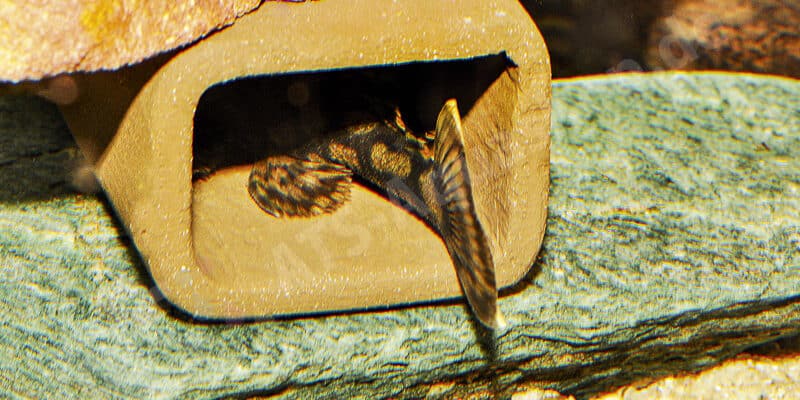
Brood-caring male of Ancistrus sp. (L 519), photo: Ingo Seidel
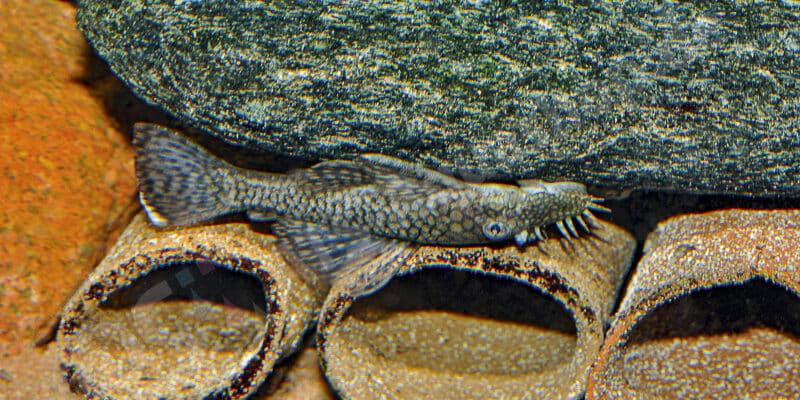
In the breeding tank, enough breeding caves should be available to choose from, photo: Ingo Seidel
Water parameters & oxygen – what really counts
For breeding, not “perfect numbers” are decisive, but:
- stable values
- very good water quality
- sufficient oxygen
Temperature
Many breedings run well in the range of 24-28 °C. Warmer often accelerates development, but can also increase stress.
Oxygen & Hygiene
- good filtration (not oversized, but stable)
- additional ventilation/flow if necessary
- Avoid mulm traps
- regular water changes (better more often small than rarely large)
Conductivity / pH
Ancistrus are often tolerant as long as the values are stable. For many forms, breeding also works in medium-hard water. If you are working with more sensitive or wild-caught forms, softer water can help – but stability is more important than extreme values.
More details on flow, filter systems and water care can be found here: Care, Keeping & Feeding.
Feeding for conditioning (“breeding food”)
Base (vegetable & high in fiber)
- Zucchini, cucumber, pumpkin, paprika (sparingly)
- high-quality catfish tabs / spirulina
- Aufwuchs surfaces (stones/roots)
Protein (moderate, but targeted)
Protein can contribute to conditioning, but too much can pollute the water.
Suitable (depending on species and tank):
- Frozen food (e.g. mosquito larvae) in small quantities
- good granules
- occasionally artemia/similar
Tip: If the water tips, the rearing tips. Better clean and constant than “too much of a good thing”.
Mating, clutch, brood care – what happens in the cave?
Mating
The female lays the eggs in the cave, the male fertilizes them. Then the male takes over the brood care.
Brood care by the male
- fans water over the eggs (oxygen supply)
- removes unfertilized or fungused eggs
- defends the entrance
Important: In this phase, do not disturb if possible. Do not constantly lift the cave, do not constantly reach into the tank.
Depending on the temperature, the larvae hatch after a few days. The male usually stays with the brood until the young fish leave the cave.
Rearing the young – the most important part
The first days
As long as the yolk sac is present, the young hardly eat actively. After that they need:
- Aufwuchs
- fine, easily digestible food
- absolutely clean water
Food for young fish
Proven:
- finely crushed catfish tabs
- fine granules
- blanched vegetables, cut into small pieces
- possibly some protein, but minimal
Water change routine
This is often the success factor #1:
- better several times a week small changes
- consistently remove food residues
- do not “clean to death” the filter, but keep it stable
Frequent problems – and how to solve them quickly
Eggs become moldy
Causes: too little oxygen, too much organic pollution, poor flow in the cave
Solutions: more ventilation, cave more streamlined, water change, reduce mulm
Clutch disappears / is eaten
Causes: Stress, disturbance, wrong socialization
Solutions: more peace, more caves, if necessary breeding tank
Young die after 3–14 days
Causes: Water quality, overfeeding, bacterial contamination
Solutions: feed less, change more often, aufwuchs surfaces, hygiene
Male leaves the cave
Causes: Disturbance, unsuitable cave, too much competitive pressure
Solutions: test other cave, improve location, reduce competition
Popular breeding forms in the hobby (aquarium strain)
Many search terms on the net refer to breeding forms of Ancistrus sp. “Aquarienstamm”. Here you will find the most important profiles including typical trade names and information on classification:
Yellow-Black Eye
Yellow breeding form with dark eyes. Often inconsistently referred to as “L144″/”Gold” in trade/online – in the profile we explain the common confusions.
Albino
Light breeding form (usually with reddish eyes). Husbandry and breeding principles correspond to the aquarium strain – condition, caves and clean water quality are important.
Super Red
Red breeding form, whose color intensity can vary depending on the line, age and feeding. The profile contains practical information and a clean classification of the designations.
Breeding L-catfish & undescribed forms
If you keep many L-numbers / undescribed Ancistrus, the basic rules still apply – but:
- some forms are more territorial
- cave size and constriction can be more crucial
- Group composition (2 M / 3 F) may work better than a pair
If you are working with L-numbers: first check the assignment in the species list before deriving breeding goals.
Frequently Asked Questions About Keeping Bristlenose Catfish
Important Note: The following answers refer to the widespread “common” Bristlenose Catfish, i.e., typical aquarium strains of Ancistrus sp. in a community aquarium. Many wild-caught or specialized species have significantly different requirements. For such animals, please always consult the respective species profiles and literature references.
How many caves do I need for breeding?
At least one suitable cave per breeding male – better several, so that the male can choose and stress decreases.
Do I need soft water for Ancistrus breeding?
Often not. Stability, cleanliness and oxygen are usually more important than extreme values.
What is the most important thing for rearing?
Water quality. Frequent small water changes and sparing feeding beat “special food”.
Can young fish grow up in the community tank?
Sometimes yes, but losses are more frequent. For a high success rate, a rearing/breeding tank is better.
Learn more in the standard reference work on Ancistrus
This overview can only provide a glimpse into the fascinating world of Bristlenose catfishes. Anyone who would like to delve deeper—from systematic details about the diversity of species to practical experience reports and extensive photos—will find a comprehensive description of the genus in the book “Bristlenose Catfishes: The Plecos of the Genus Ancistrus”
Many species are represented on ancistrus.at with brief profiles and pictures. The book supplements this information with detailed descriptions, further reading references, and extensive background information on the biology and ecology of Bristlenose catfishes.