
The question, “Is my Ancistrus catfish a male or a female?” arises sooner or later in almost every Ancistrus tank. Sex determination is important for targeted breeding, but also for harmonious group keeping in larger aquariums. The genus Ancistrus exhibits pronounced sexual dimorphism, which can be recognized primarily by the head and certain bony ridges – but there are also exceptions.
This article discusses how to determine the sex of an Ancistrus as reliably as possible, at what size differences become visible, and in which cases even experienced catfish enthusiasts need to look more closely.
Typical sex differences in Ancistrus
The most well-known characteristic that distinguishes Ancistrus catfish from many other armored catfish is the fleshy tentacles on the heads of adult animals. In most Ancistrus species, males, in particular, bear larger, branched tentacles centrally on the head and along the snout’s edge. Females often have only small skin growths on the front edge of the snout or no visible tentacles at all.
With increasing age, males also develop stronger so-called odontodes – small dermal denticles – on their gill covers and along their pectoral fin rays. These structures are erected during dominance fights and territorial defense and are significantly more pronounced in adult males than in females. Males are often more robust overall, have a broader head, and appear ‘stockier,’ while females appear somewhat rounder and fuller in the abdominal area, especially when gravid.
1. Head and tentacles – the most important characteristic
The most reliable and striking difference in many Ancistrus species is the shape and number of tentacles on the head. Typically:
- Males develop significantly longer, branched tentacles directly on the head above the snout. These can appear like a small ‘antler crown’.
- Females, if any, only have short tentacles along the edge of the snout; the head remains smooth in comparison.
In practice, a key indicator is that an Ancistrus with prominent ‘antlers’ on its head is almost certainly a male.
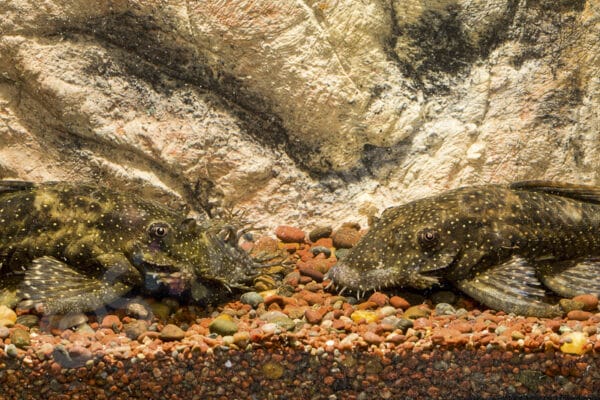
Pair of Ancistrus alga “Rio Tapiche” (male on left), Photo: Andreas Tanke
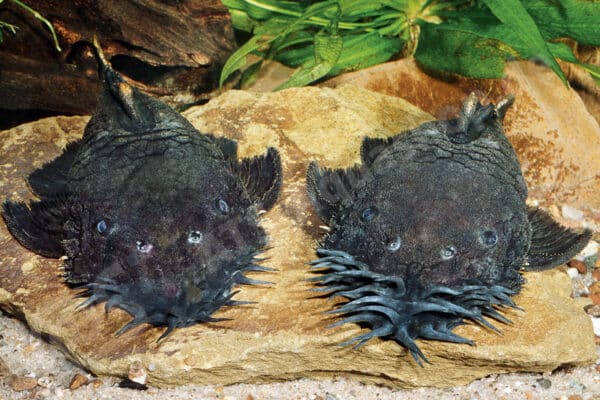
Pair of Ancistrus ranunculus, female on left, Photo: Ingo Seidel
2. Body shape and proportions
Besides the tentacles, one can also observe the body shape. Males often appear more elongated and have a broader head that distinctly ‘protrudes’ from the body. Females generally appear softer in their contours, with a less pronounced head region. From a top-down view, it is easy to see that the male’s head is relatively broader than its body, whereas in females, the head and body width transition more harmoniously.
The belly line also provides clues: Mature females develop roe and appear fuller during this time. Males tend to remain uniformly muscular, without significant rounding in the abdominal area.
3. Odontodes on gill covers and pectoral fins
Another characteristic is the odontodes, small, tooth-like structures on bony ridges. In Ancistrus males, the odontodes on the gill covers and along the anterior pectoral fin rays are significantly more developed. In a side view, adult males can be seen to have distinct ‘rows of bristles’ which they erect during confrontations with rivals.
Females also possess these odontodes, but in a much weaker form. These structures can be observed well, especially in calmly resting animals or under slight oblique lighting.

Pectoral spine of a male with tentacle growth, Photo: Ingo Seidel
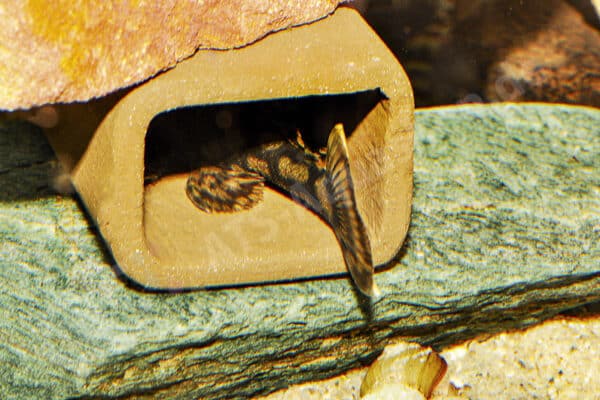
Brood-caring male of Ancistrus sp. (L 519), photo: Ingo Seidel
4. Behavior: Territory formation and brood care
Behavior is not a sole distinguishing feature, but it supports the assessment. In a well-structured aquarium with several caves and roots, an adult male will usually begin to claim a cave for itself, regularly ‘cleaning’ it and driving away competitors. During brood care, the male leaves the cave only briefly to feed and guards eggs and larvae for days.
Females, on the other hand, tend to patrol the tank, use caves only briefly for egg-laying, and do not participate in brood care. Those who observe the aquarium closely over a longer period often recognize a clear ‘cave male’ and several less territorial animals – another indication of sex distribution.
When is sex determination possible?
In very young Ancistrus, reliable sex determination is hardly possible. Only with increasing growth – depending on the species, from about 4 cm body length – do the tentacles begin to become visible in males. At this point, initial differences can often be recognized in groups, even if the final development becomes even clearer later.
Those who want to be sure either buy a group of juveniles and await their development, or specifically select animals where the typical characteristics are already clearly developed.
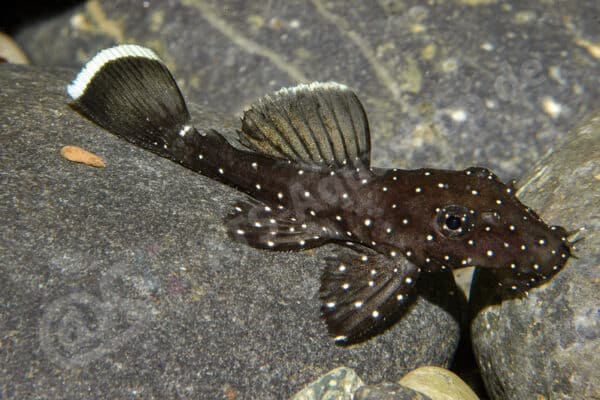
Approximately 4 cm juvenile Ancistrus sp. (L 071) showing first tentacles on the head, Photo: Ingo Seidel
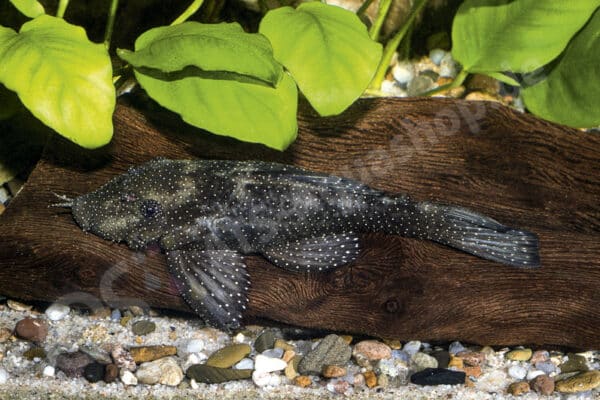
Female of Ancistrus sp. (L 071) from the Rio Tapajós, Photo: Ingo Seidel
Exceptions and special cases
As clear as the sex differences are in many ‘Common Ancistrus‘, it is important to note that there are species within the genus with divergent characteristics. In some species, females also have comparatively large tentacles; in others, the differences are generally more subtle. Albino forms can also complicate assessment because contrasts are lower.
In such cases, consulting specialized literature and detailed species profiles helps. Reliable determination is often only possible by comparing several adult animals of the same species or lineage.
Conclusion: Reliably Identifying Sex in Ancistrus Catfish
Anyone wishing to determine the sex of their Ancistrus catfish should not only look at a single characteristic but combine several factors: tentacles on the head, body shape, odontodes, and behavior. For the Ancistrus forms commonly available in trade, reliable sex determination is usually quite possible from a certain size.
Once you have reliably identified the males/females, the next step will be easier: Breeding Guide.
For even more detailed information on individual Ancistrus species, their sexual dimorphism, and typical physical characteristics, see the standard reference work “Antennenwelse: Die Harnischwelse der Gattung Ancistrus” (Antenna Catfish: The Armored Catfish of the Genus Ancistrus). It provides detailed information on described species, L-numbers, and variants – an ideal supplement to the practical information on Ancistrus.at.
If you would like to delve deeper into the basics, take a look at our article on keeping Ancistrus catfish in the aquarium. You can find an overview of described and undescribed forms in the Ancistrus species list.
All Ancistrus Species at a Glance
In the article, you could learn how to distinguish between males and females. If you want to delve even deeper into the world of bristlenose catfish, it is worth taking a look at the standard work “Bristlenose Catfishes: The Plecos of the Genus Ancistrus”.
There, described species, L-numbers, and variants are presented in detail.